A Curious Path from Southern Spain to Cambridge
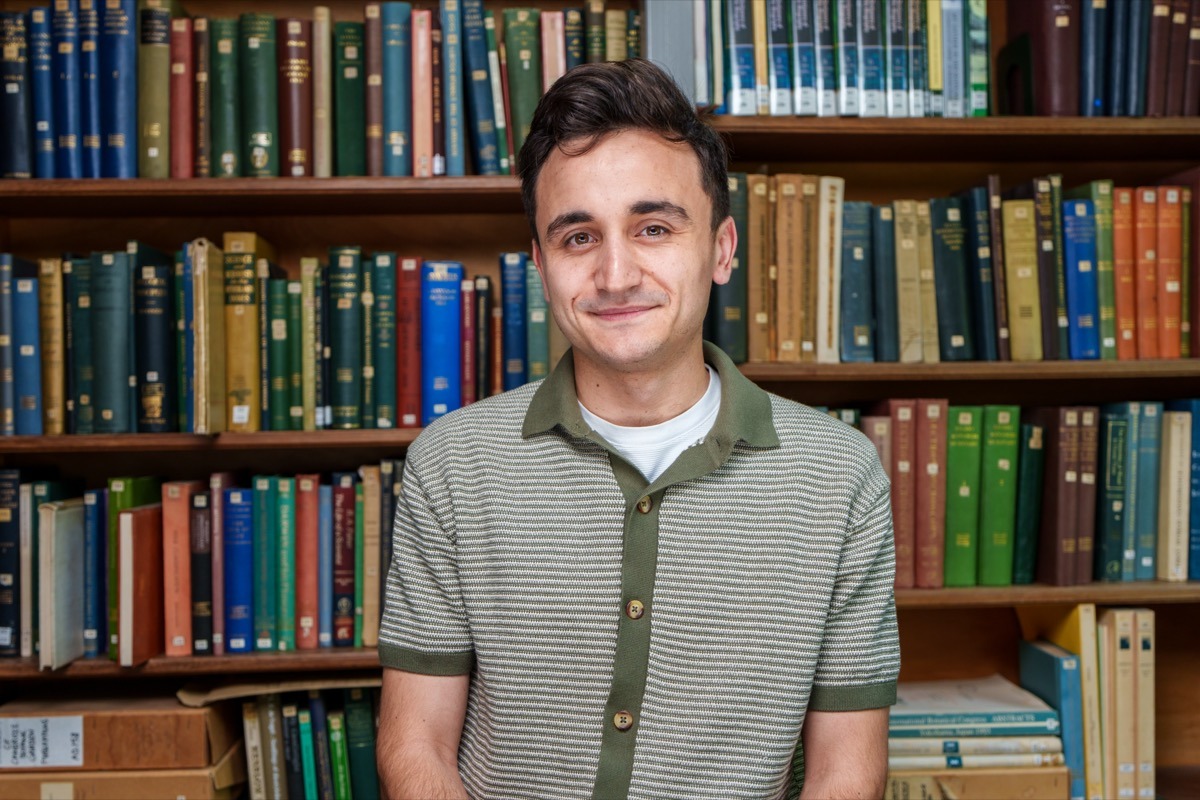
Raw curiosity. That is what has driven Jacob González Isa to pursue some of life’s biggest questions as a plant biologist. Growing up in a working class family in Southern Spain, he did not know what biotechnology was, let alone potential pathways to pursue it.
“I’m a first-generation university student, so my parents were not able to tell me anything about life sciences, about biotech, or even about the university,” he recalls. “So, in the end it was simply pure curiosity, with my family’s support, that drove me to where I am.”
A PhD student now at the University of Cambridge, González Isa not only studies key evolutionary questions but also works to help other first-generation students feel more prepared and empowered to pursue biotechnology. González Isa says that his Amgen Scholars experience in 2022 was a turning point in his educational pursuits.
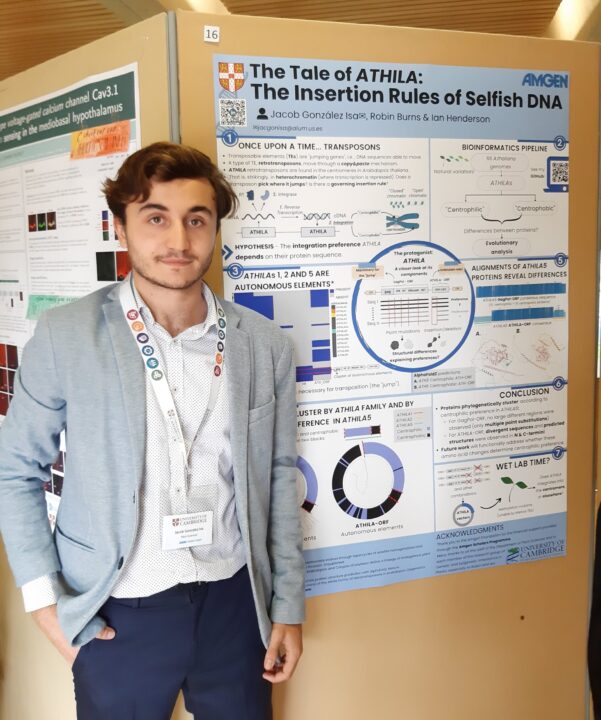
Coming out of the COVID-19 pandemic, Amgen Scholars, also at Cambridge, was González Isa’s first research internship. He worked with Professor Ian Henderson, a plant scientist who studies epigenetics, and became intrigued by the “paradox of the centromere.” The centromere is the critical middle part of the chromosome, without which cell division would not be possible, and yet, scientists do not understand how it works. It somehow stays identical across organisms while the underlying DNA rapidly evolves.
“I didn’t care about plants or human biology,” González Isa says. “I was simply again following the question.” Unraveling the paradox could be a gamechanger for synthetic biology, Isa says, because it will be important to creating human or plant artificial chromosomes. Such a development could expedite the development of solutions to some persistent global challenges, such as food insecurity and climate change. “We would be able to boost the generation of compounds for a plant and really tailor a plant to your needs in an unsuspected way,” he says. “It’s a way to move from genetic engineering to genomic engineering.”
Returning to the University of Cambridge for graduate school after his Amgen Scholars program there, González Isa has also reflected on the importance of gaining international research exposure along his path. He received Erasmus scholarships — funding from the European Union — to study for one year at the University of Turin and for a research internship at the Institute of Science and Technology in Austria while he was an undergraduate at the University of Seville, in addition to getting a master’s degree in computational biology in Madrid.
All of these experiences introduced him not only to new places but also to like minded people who were exemplars in scholarship, entrepreneurship, and volunteering. “These things I didn’t know about that people do in the university, I tried to replicate them,” he says, and “I am involved in those types of activities today.” Amgen Scholars, he says, was the start of realizing he could be a researcher and closing the gaps of his first-generation university background, including “closing the gap between the South of Europe and the top institutions of Europe and becoming more confident.”
Through an NGO called Red Pioneros (translated as “Pioneers Network”), González Isa also now works with high schoolers who are first-gen university students to facilitate their transition to the university, including then helping them to apply for fellowships and other opportunities. This is in addition to his work with Nucleate, a well-established organization in biotech entrepreneurship, his dream endpoint. “I would have appreciated more resources to help me navigate the real world,” he says. “If you cloned me 100 times, perhaps only 10 to 20% of the time, I would be able to today be doing a PhD in Cambridge.”